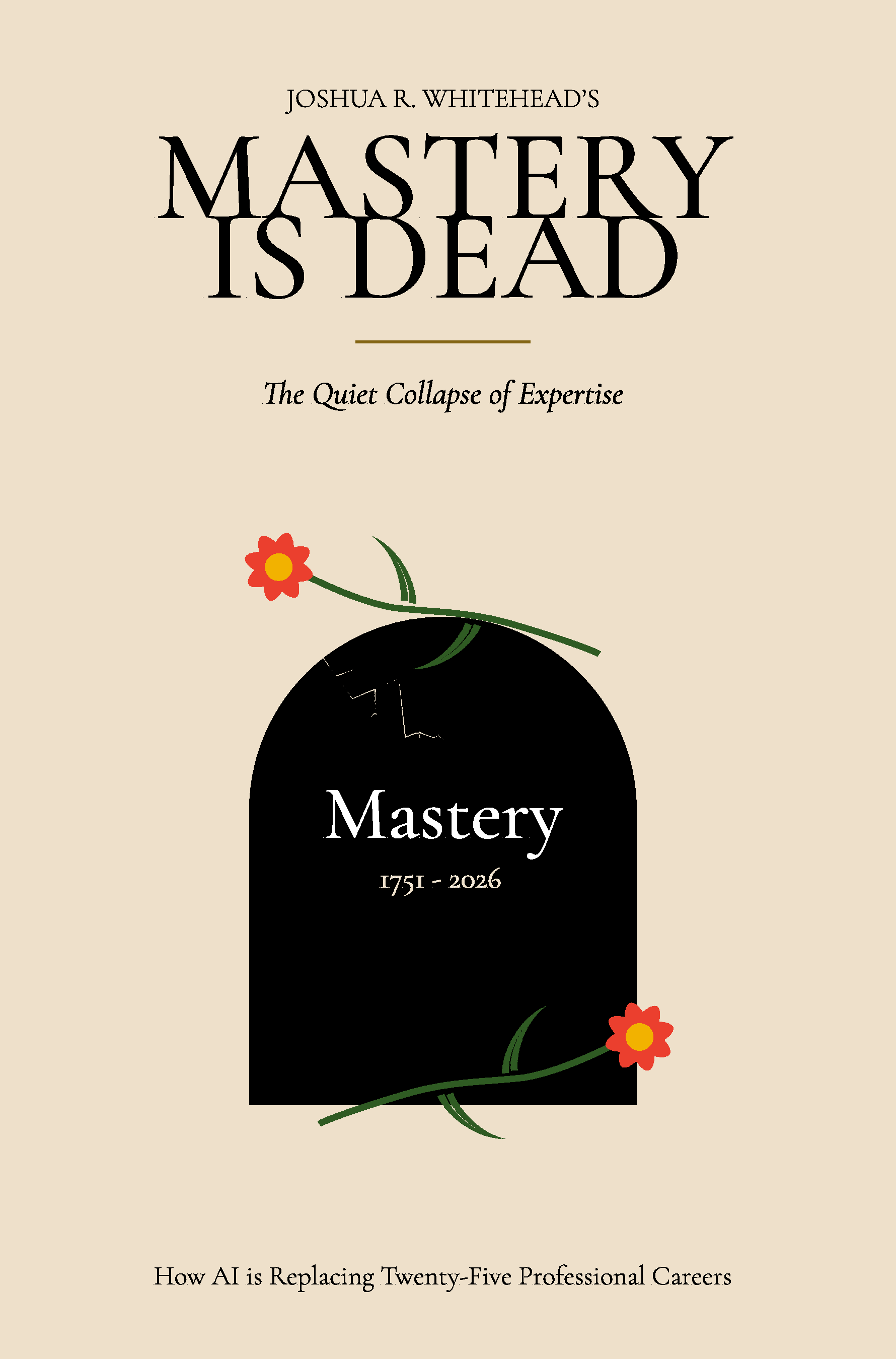
A book by Joshua R. Whitehead
Mastery
is Dead
The Quiet Collapse of Expertise
How AI is replacing twenty-five professional careers faster than the people inside them have absorbed.

“Expertise isn’t being replaced. It’s being compressed — and the people inside it are the last to feel the floor give way.”
What’s inside
A field manual for the collapse of expertise
The pattern, named
Compression, not replacement. The work doesn't vanish — it collapses inward, and far fewer people are needed to hold what remains.
Twenty-five careers, examined
Each chapter takes one profession seriously: what the job actually is, where the floor is giving way, and how fast the water is rising.
What I would do
No false comfort and no doom. Every chapter ends with a clear-eyed account of what survives, and what a person inside that career can do now.
The twenty-five careers
Five parts. Twenty-five professions. One pattern.
From the software engineer to the insurance underwriter, the book moves through the white-collar economy one career at a time. Hover any profession for the one-line argument.
Part I
The Code and Numbers People
The professions where AI compression has been most aggressive and where the evidence is overwhelming.
- 01The Software EngineerThe canary. Whatever is happening to the engineer arrives for every other career within two to five years.
- 02The Data AnalystThe compression nobody is talking about, because the engineer takes all the attention.
- 03The Financial AnalystThe career built on the model — and the model is now a prompt.
- 04The AccountantThe most quietly consequential profession in the economy, compressing in plain sight.
- 05The ActuaryThe smallest, most credentialed profession in the book — and credentials only slow the tide.
Part II
The Word People
The professions where language is the product.
- 06The CopywriterThe career most thoroughly compressed by AI in the entire book.
- 07The Content WriterBuilt on the premise that the internet would always need more text. It doesn't.
- 08The JournalistThe only career here that has been compressing for twenty-five years.
- 09The TranslatorHeld up for decades as the profession safe from automation. It wasn't.
- 10The Technical WriterThe most invisible career in the book — absorbed into the tooling itself.
Part III
The Visual People
Where execution is collapsing fastest and taste is becoming the only durable asset.
- 11The Graphic DesignerExecution collapses; taste becomes the only durable asset.
- 12The Product DesignerFrom producing screens to deciding what is worth producing.
- 13The PhotographerBelieved reality itself protected the work. Synthetic images don't care.
- 14The Video EditorThe visual profession in the earliest stage of its compression.
- 15The IllustratorThe profession that fought back hardest, and lost.
Part IV
Builders of Companies
The connective-tissue careers — built on translation, integration, and coordination.
- 16The Product ManagerDefined entirely by what it sits between — and the gaps are closing.
- 17The Project ManagerA profession that was always an argument about whether it should exist.
- 18The Management ConsultantThe $2M engagement, approximated by an executive with the right tools in two weeks.
- 19The Marketing ManagerConnective-tissue work, compressed from both the production and strategy sides.
- 20The Operations ManagerThe role that runs everything quietly — now running on a smaller team.
- 21The RecruiterMatching candidates to roles is exactly what these models do natively.
Part V
Advisors and Gatekeepers
The careers that exist because knowledge used to be hard to access — and what happens when the asymmetry collapses.
- 22The LawyerThe most institutionally protected profession — protection buys time, not immunity.
- 23The Real Estate AgentThe weakest protections going in, and the trajectory shows it.
- 24The HR GeneralistProtections that are defensive, not offensive. Mostly unlicensed, fully exposed.
- 25The Insurance UnderwriterThe book closes where Part One opened: pricing risk, now automated.
Where to start
A reader’s path
- 01
Start with the canary
Read the Software Engineer chapter free. It is the early-warning system for every other career in the book.
Read the sample → - 02
Find your own profession
Twenty-five careers, grouped into five parts. Locate yours and read the one-line argument before you commit.
Browse the 25 careers → - 03
Read the whole argument
The chapters build on one another. The full 618-page book is the field manual — the compression, and what to do about it.
About the book →
The author
Joshua R. Whitehead
I run a design agency and a portfolio of software products. I have spent my working life inside several of the careers in this book — designing, building, writing, and operating — which is why I keep insisting on the difference between what reads well from the outside and what the work actually is.
This book is the most honest account I could write of what I see happening to professional work, and what I would do if I were standing inside each of these careers right now.
More about Joshua →Stay close to the argument
Notes from the collapse
New essays, chapter excerpts, and field notes as the picture keeps developing. Thoughtful and infrequent.
The book is the product.
Paperback · 618 pages. Now on Amazon.